


Small pool, whole summer
Your yard is smaller than the brochure pools, and you still want to swim every day from May to September. That is the pool we build.
Building pools on Long Island since 2009.
Nassau #158301 and Suffolk #HI-64117. The numbers are on every page of this site, not just this one.
It goes through your local building department, and in Nassau and Suffolk an incorporated village often runs its own. We confirm what applies where you are before we design.
We build all three, so we are not tied to recommending one construction type. The recommendation follows your yard and your access.
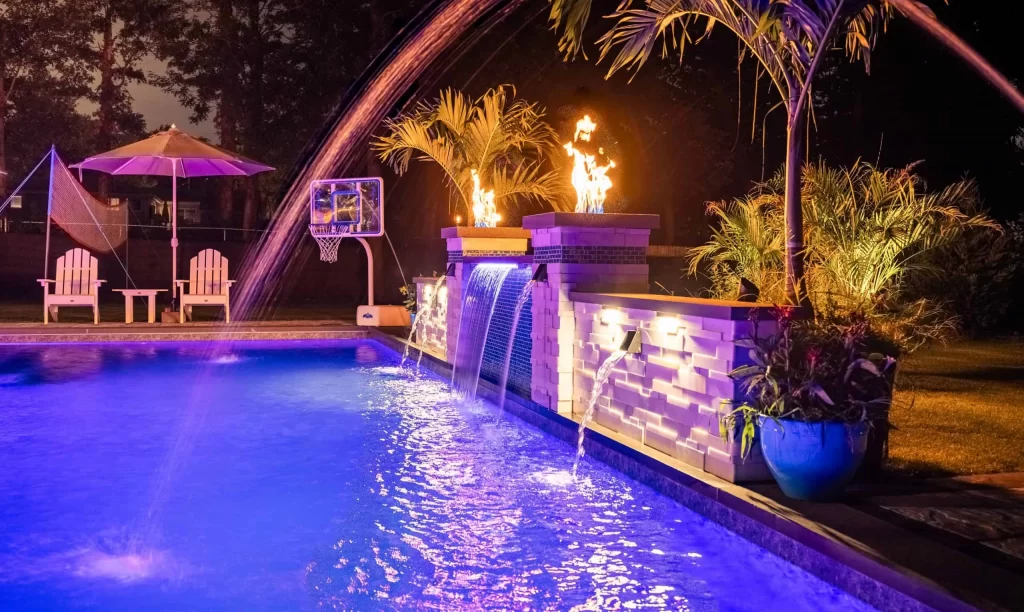
A plunge pool is a small inground pool built for cooling off, sitting in and using every day rather than swimming laps. It is deep enough to stand in up to your chest or submerge fully, in a yard where a full-size pool would eat most of the yard.
What makes it worth considering is not the size. A smaller body of water costs less to heat, less to chemically balance and less to open and close every year, while still being a real inground pool that stays with the property.
The same pool gets sold under a lot of names. A cocktail pool, a spool, a tuxedo pool, a garden pool, a splash pool and a dipping pool all describe the same idea. The names tell you nothing about how the pool is built, so compare the specification and not the label. If a quote uses one of these words, ask which construction type it means, how deep it goes, and what is included.

A small pool you actually use every day
Published plunge pool dimensions disagree with each other. A national supplier lists a standard four-foot depth; a New York builder’s guide says up to seven feet. Published length ranges run around ten to twenty-two feet, with width most often quoted at six and a half feet and up. Both ends of that describe real pools, because a plunge pool gets sized around how it will be used rather than to a fixed spec.
What actually decides your dimensions, in order:
Features that earn their place on a pool this size:
As a cold plunge. An inground plunge pool with a heater and a chiller is usable most of the year here: warm through the shoulder season, cold on purpose in summer. Running both is far more practical on a small volume of water than on a full-size pool. If what you want is hot water and jets rather than a pool, a hot tub or spa is the cheaper answer.
New York’s Uniform Code sets the safety requirements for a residential pool, and the detail sits in the Residential Code of New York State. Three of them catch people out.
There is also a clock that starts at the permit, and it is the one people are most often surprised by. Where a temporary fence is used during an inground installation, it has to be replaced by a permanent compliant enclosure within ninety days of the permit being issued or the installation starting, whichever is later. Your building department can grant a waiver for good cause, bad weather included.
Your local building department does. Every city, town and village in New York administers and enforces the Uniform Code in its own jurisdiction, so in Nassau and Suffolk an incorporated village often runs its own permitting rather than the surrounding town. Worth settling before you assume which counter you are standing at.
Suffolk County Health gets mixed up with this a lot. Their pool permitting program covers public bathing facilities, so it is not where a backyard pool gets permitted. Where they can still matter on a residential job is sewage disposal and water supply: if the work affects your septic system or cesspool, that goes through their Office of Wastewater Management as a separate review with its own timeline.
Setbacks, lot coverage and fence rules sit on top of the state requirement and are zoning, which is local and can be stricter than the state minimum. We confirm what applies at your address with the building department before designing, rather than after you have paid for a plan that will not pass.
Access decides the price. A plunge pool is small. Getting the equipment to it often is not, and it is worth settling early because access is often one of the largest single factors in the cost.
A shell shipped in from out of state does not change any of that. Somebody still has to get it into the yard, set it level, tie in the plumbing and electric, pass inspection, and be there for service and support afterwards.
We build all three, so we are not tied to recommending one construction type. For a plunge pool specifically:
Weighing them in general rather than for a plunge pool? We compare pool types side by side, and there is a closer look at gunite versus fiberglass on cost.
Everything above describes an inground pool. For plunge pools in Queens we build above ground, and on a lot of city lots that is the better answer rather than a compromise.
An above-ground plunge pool goes in faster and costs less, usually with no excavation and no spoil to truck off, and on a tight lot with no equipment access it is often what works. You give up the permanence of an inground pool. Resale effects depend on the property and the buyer, so treat that as a conversation rather than a given.
If you are in Nassau or Suffolk and your access or your budget rules out an inground build, say so early and we will price both.

Small yard, real pool, permitted and built by people who work in your town. Send a photo of the yard and your survey and we will tell you what fits, what it takes to get it in there, and a realistic starting price range.
Inground plunge pools across Nassau County and Suffolk County, above ground in Queens. Every town we cover is on the areas served page.
| What you will read | What it actually means |
|---|---|
| A plunge pool “starting at just” a low five-figure number | Read what that figure covers. A headline price in this market is commonly the shell with a pump and filter, delivered. Excavation, spoil removal, crane or access work, the base, the electrician, the plumbing tie-in, permits, coping, decking and code-compliant fencing are usually all outside it. |
| That you do not need a local builder | Somebody still has to file your permit, pass the inspections, meet New York’s alarm and gate requirements, and answer the phone in year three. That work happens locally whoever supplies the pool. |
| That Suffolk County Health permits your pool | Their pool program covers public bathing facilities, not backyard pools. They can still be involved in your septic and water supply, which is a different review. |
| That a plunge pool is basically a big hot tub | They are treated differently under the state rules. A spa with a compliant safety cover is exempt from both the alarm and the gate requirements. A pool with an automatic power cover is exempt from the alarm only, and still needs its enclosure. |
| Small pool, so it must be quick | A smaller pool does take less time to build, but the permit review does not shrink with it, and that is usually what sets your overall timeline. |
| “Licensed and insured” | Everyone says it. Ask for the numbers. Ours are Nassau #158301 and Suffolk #HI-64117. |
Access, material and what is already in the ground set your number, in that order. Advertised plunge pool prices are commonly shell prices rather than finished pools, so here is what actually moves it.
Ask any builder, including us, what their number includes: the permit filing, the inspections, the equipment set, the electrical and plumbing tie-in, and putting your access route back the way they found it. A quote that leaves those out is not comparable to one that puts them in.
1
A drivable path is one price. A crane over the roof is another. Measure your narrowest gate opening early, because access is often one of the largest single factors in the number.
2
Gunite in a custom footprint, a fiberglass shell, or a vinyl liner are three different numbers before anything else is decided.
3
Deeper means more material out and more trucking, and sometimes rock or groundwater to deal with.
4
A cesspool, a septic field, sprinkler lines, gas and electric services or tree roots all move where the pool can physically sit.
5
A code-compliant enclosure is not optional, and the deck around a small pool is often a bigger area than the pool itself.
6
A Baja ledge, a bench, heating, a chiller, lighting and water features are each a real adder.
7
It comes from your local building department, town or village depending on where you are. The permit is usually what sets your timeline, not the digging.
8
A small pool still needs a dedicated electrical run and a water fill. How far that run has to travel from your panel is a real line item.
9
Permit review, a build slot and material lead times all sit between signing and swimming. Planning and permitting earlier, through autumn or winter, improves the chance of being finished for the spring.
You cannot swim laps in it. Beyond that: resale appeal can be narrower than a full-size pool depending on the property and the buyer, a small water volume changes temperature faster in both directions so the chemistry needs a lighter and more regular hand, and the cost per square foot runs higher than a big pool because the expensive parts (excavation, access, equipment, permits, fencing) barely shrink when the pool does. If you have the yard and the budget for a full-size pool and you want to swim, build that instead.
Yes if you want to use a pool rather than swim in one, and especially if a full-size pool will not fit. No if you want laps, and no if what you really want is hot water and jets, in which case a spa is cheaper and better. We will tell you which one you are describing.
Published figures run from about four feet to about seven. Shallower keeps the whole pool standable and is the cheapest to heat. Deeper lets you submerge fully and suits cold-plunge use. There is no single ideal, which is why the number varies so much between sources.
Yes, from your local building department. In Nassau and Suffolk that can be the town or an incorporated village, depending on where you are. It is an inground pool, so it gets permitted and inspected like one regardless of how small it is.
A new pool in New York needs an alarm that detects a child entering the water and sounds audibly, unless it has an automatic power safety cover meeting ASTM F1346, which can stand in for the alarm. Gates in the enclosure have to be self-closing, self-latching and childproof-locked whenever the pool is not in use or supervised. Your local fence and setback rules sit on top of that and can be stricter, so we confirm yours before designing.
Access, material and what is already in the ground set it, in that order. Advertised figures are commonly shell prices rather than finished pools. Send us your town, a photo of the yard and your survey and we will give you a realistic starting price range before anyone visits.