Summary:
If you’re installing a pool in Nassau County, NY, you’re facing more than just construction decisions. The gate you install affects your insurance premiums, your legal liability, and whether you’ll pass final inspection. Get it wrong, and you’re looking at failed inspections, coverage gaps, or worse—liability if someone gets hurt.
Nassau County has specific requirements that differ from general New York State codes. Your insurance company has its own checklist. And if these don’t align with what actually gets installed, you’re the one dealing with the consequences. Here’s what you need to know about pool gate installation requirements and how they impact your insurance coverage.
Pool Permit Requirements in Nassau County
Nassau County doesn’t mess around with pool permits. You need one before you start construction, and the Building Department reviews everything from your site plan to your safety features before approving anything.
The permit process involves submitting detailed pool plans, property surveys, and proof of compliance with local codes. Most homeowners pay between $150 and $400 for permits, plus a $300 review fee each time the county examines your plans. Skip this step or try to work around it, and you’re risking stop-work orders and fines that cost far more than the original permit.
Your pool can’t be used legally until you have a Certificate of Occupancy. That means passing all required inspections, including verification that your gate meets safety standards. Without it, you’re operating illegally and your insurance coverage could be void if something happens.
Pool Plans for Permit Approval
Getting your pool plans approved in Nassau County requires more documentation than most homeowners expect. You’ll need signed and sealed drawings from a licensed New York State Professional Engineer or Registered Architect, a detailed site plan showing setbacks from property lines, and an engineering report specifically for swimming pool construction.
The county wants to see exactly where your pool sits on your property, how far it is from structures and property lines, and how your drainage system handles runoff. Nassau County requires pools to be at least 10 feet from property lines in most jurisdictions, and your plans need to show this clearly.
Your gate specifications matter during this review. The Building Department checks that your plans include a self-closing, self-latching gate with the latch mechanism positioned correctly. If your drawings show a gate that doesn’t meet code, your application gets kicked back for revisions. That delays your timeline and adds costs.
The documentation process also includes letters from your engineer and architect confirming they’ve designed everything to code, plus verification of sewer availability from your local district. All of this gets submitted together. Missing one piece means starting over with another review cycle and another $300 fee.
Most contractors who specialize in Nassau County pool construction handle this entire process. They know what the Building Department wants to see, how to prepare compliant drawings, and how to avoid the common mistakes that cause delays. Trying to navigate this yourself often results in multiple revision cycles that push your project back weeks or months.
Nassau County Pool Gate Code Requirements
Nassau County follows New York State Residential Code Section R326 for pool barriers, but some municipalities within the county have stricter requirements. The baseline standard requires fencing at least 48 inches (4 feet) tall measured from the finished ground level. Some areas like the Town of Hempstead mandate 5-foot fences, exceeding the state minimum.
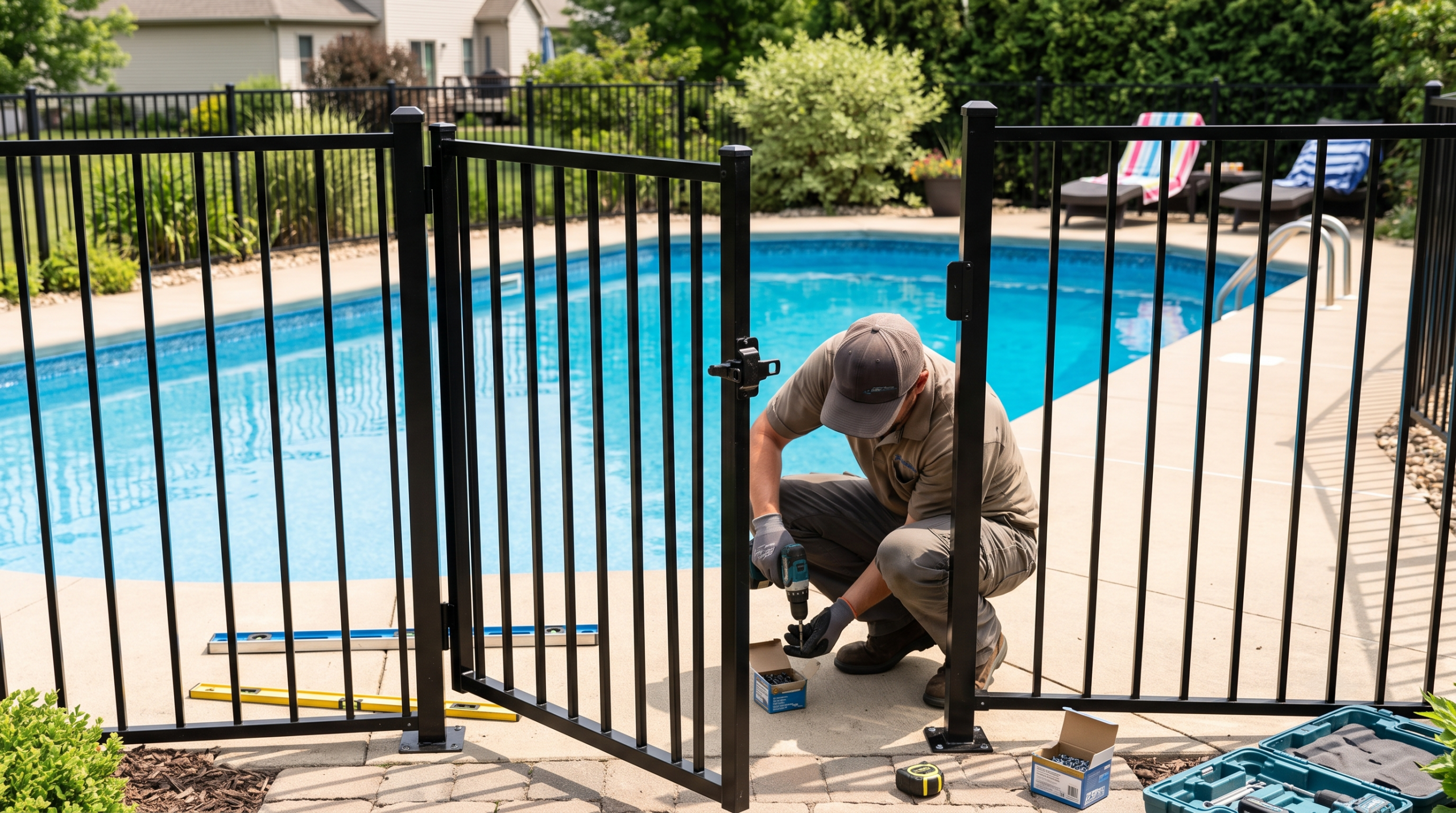
Your gate must be self-closing and self-latching. That means it automatically swings shut and engages a latch without anyone touching it. The latch mechanism has to be located on the pool side of the gate, at least 40 inches above the ground. This height keeps it out of reach of young children who might try to open it.
The gap between the bottom of your fence and the ground can’t exceed 2 inches in most cases, though some jurisdictions allow up to 4 inches. Larger gaps create a safety hazard where children or pets could squeeze through. Your fence also can’t have horizontal bars or footholds that make it easy to climb.
Gates must swing away from the pool area, not toward it. This prevents someone from being able to force the gate open if there’s any resistance. The entire barrier—fence and gate combined—needs to completely surround the pool with no gaps that allow unsupervised access.
These aren’t suggestions. They’re legal requirements that get checked during your final inspection. If your gate doesn’t meet these specifications when the inspector shows up, you fail. That means no Certificate of Occupancy, no legal pool use, and potentially having to tear out and reinstall a gate that cost thousands of dollars.
The specific requirements can vary slightly depending on which Nassau County municipality you’re in. Hempstead, Oyster Bay, and North Hempstead each have building departments that may interpret codes differently or add local requirements. Contractors familiar with your specific area know these nuances and install gates that pass inspection the first time.
Pool Insurance Requirements and Coverage Impact
Your homeowners insurance company cares about your pool gate for one simple reason: liability. Pools are considered “attractive nuisances” under New York law, meaning you can be held liable if a child trespasses and drowns in your pool. Insurance companies know this, and they adjust your coverage and premiums accordingly.
Most insurers require you to notify them before installing a pool. Once they know you have one, they’ll likely increase your liability coverage requirements. Standard homeowners policies typically include $100,000 to $300,000 in liability coverage, but pool owners usually need $300,000 to $500,000. Some insurance companies won’t cover pools at all without proof of compliant safety barriers.
Your premium will increase. On average, adding a pool raises your homeowners insurance costs by about 10% of your dwelling coverage amount. If your home is insured for $400,000, expect your pool to add roughly $40,000 in coverage needs and corresponding premium increases. The exact amount depends on your insurer, your pool type, and what safety features you have installed.
Swimming Pool Liability Insurance and Safety Requirements
Swimming pool liability insurance specifically covers injuries or deaths that occur in or around your pool. This falls under the personal liability portion of your homeowners policy, but it becomes significantly more important once you have a pool.
Insurance companies evaluate your pool safety features before determining coverage and rates. A compliant four-sided isolation fence with a self-closing, self-latching gate demonstrates you’ve taken reasonable precautions to prevent unauthorized access. This can work in your favor when negotiating coverage terms.
Without proper safety barriers, you face several problems. Some insurers will deny coverage entirely. Others will provide coverage but at substantially higher premiums. If you have a pool accident and your gate wasn’t compliant with local codes, your insurance company could deny your claim entirely, leaving you personally liable for medical bills, legal fees, and potential settlements.
The legal concept of “attractive nuisance” means children are naturally drawn to pools, and property owners have a duty to prevent access. Courts have consistently held pool owners liable for drowning deaths even when children were trespassing. Your insurance company knows this legal precedent, which is why they’re strict about safety requirements.
Some insurers offer discounts for additional safety features beyond the minimum requirements. Installing pool alarms, covers that meet ASTM standards, or security cameras around your pool area might qualify you for reduced premiums. These features show you’re serious about safety and reduce the insurer’s risk exposure.
Your liability coverage needs to account for worst-case scenarios. A drowning death or severe brain injury from a near-drowning can result in multi-million dollar settlements. If your liability coverage maxes out at $300,000 and you face a $2 million judgment, you’re personally responsible for the difference. Many pool owners purchase umbrella policies providing an additional $1 to $5 million in liability coverage specifically because of this risk.
How Non-Compliant Gates Affect Insurance Claims
When an accident happens and you file an insurance claim, one of the first things the adjuster investigates is whether your pool safety features met code requirements at the time of the incident. A gate that doesn’t self-close properly, a latch positioned too low, or fencing with gaps that allowed access all become evidence that you didn’t take reasonable precautions.
Insurance companies can deny claims based on non-compliance. If your gate was supposed to be self-latching but the mechanism was broken or never installed correctly, the insurer can argue you were negligent. That denial leaves you paying all costs out of pocket—medical bills, legal defense, and any settlement or judgment.
Even if your claim isn’t denied outright, non-compliance weakens your legal position. If you’re sued because someone drowned in your pool, the plaintiff’s attorney will absolutely investigate whether your safety barriers met code. A non-compliant gate becomes proof of negligence, making it harder to defend yourself and more likely you’ll face a large settlement or judgment.
Your insurance company might also non-renew your policy after a claim involving a non-compliant pool. Even if they pay the claim, they can decide you’re too high-risk to continue covering. Finding new homeowners insurance with a drowning claim in your history is difficult and expensive.
The financial impact extends beyond the immediate claim. Your premiums will increase substantially after any pool-related incident, and that increase lasts for years. A claim that could have been prevented with proper gate installation ends up costing you tens of thousands of dollars in higher premiums over time.
This is why working with contractors who understand both building codes and insurance requirements matters. They install gates that pass inspection and satisfy insurance company standards, protecting you from both legal liability and coverage gaps. Trying to save money with a cheaper installation that doesn’t meet code ends up costing far more when something goes wrong.
Protecting Your Investment with Compliant Pool Gate Installation
Pool gate installation in Nassau County involves navigating building codes, permit requirements, and insurance standards that all have to align. Get any piece wrong and you’re facing failed inspections, coverage denials, or legal liability that could cost you everything.
The requirements exist for good reason. Four-sided isolation fencing with compliant gates reduces child drowning risk by up to 83%. Proper installation protects your family, satisfies your insurance company, and keeps you on the right side of Nassau County regulations.
Working with experienced pool contractors who hold proper Nassau and Suffolk County licenses means your gate gets installed correctly the first time. We handle permits, coordinate inspections, and ensure every detail meets both code requirements and insurance standards. That’s not just convenient—it’s protection against costly mistakes that affect your family’s safety and your financial security. If you’re planning a pool project in Nassau County, we have the local expertise and regulatory knowledge to ensure your installation meets all requirements.
Questions about your pool?
Tell us what you need and a JAS Aquatics pool pro on Long Island will get back to you. Prefer to talk now? Call 631-239-8031.