Summary:
You didn’t invest in a pool just to have a rectangle of water in your yard. You wanted something more—a place that actually feels like an escape. That’s where water features come in. The sound of flowing water changes everything. It drowns out traffic noise, creates atmosphere, and turns a basic pool into something your family actually wants to use. But installation isn’t as simple as dropping in a fountain and calling it done. Plumbing, electrical work, flow rates, structural integrity—it all matters. And when it’s done wrong, you’re looking at leaks, uneven flow, or worse. Let’s talk about what actually goes into professional water features installation and why it makes a difference for Nassau County pools.
Understanding Water Features Installation for Pools
Water features installation means integrating moving water elements into your pool design—waterfalls, fountains, bubblers, spillovers, deck jets, or scuppers. Each type serves a different purpose and creates a different effect.
Some Nassau County homeowners want the dramatic cascade of a natural rock waterfall. Others prefer the clean lines of a sheer descent waterfall or the playful arcs of laminar jets. The right choice depends on your pool’s style, your property layout, and how you actually use the space.
But here’s what most people don’t realize until they’re mid-project: every water feature needs dedicated plumbing, proper flow calculations, and often separate electrical lines for pumps and lighting. It’s not decorative—it’s functional. And that’s exactly why professional installation matters.
Pool Waterfall Installation Options and Styles
Waterfalls remain the most popular choice for Long Island pool enhancement, and for good reason. A well-designed waterfall adds movement, sound, and visual interest. Natural rock waterfalls work beautifully with freeform pools and tropical landscaping. They can be built tall and dramatic or low and wide, mimicking a mountain stream.
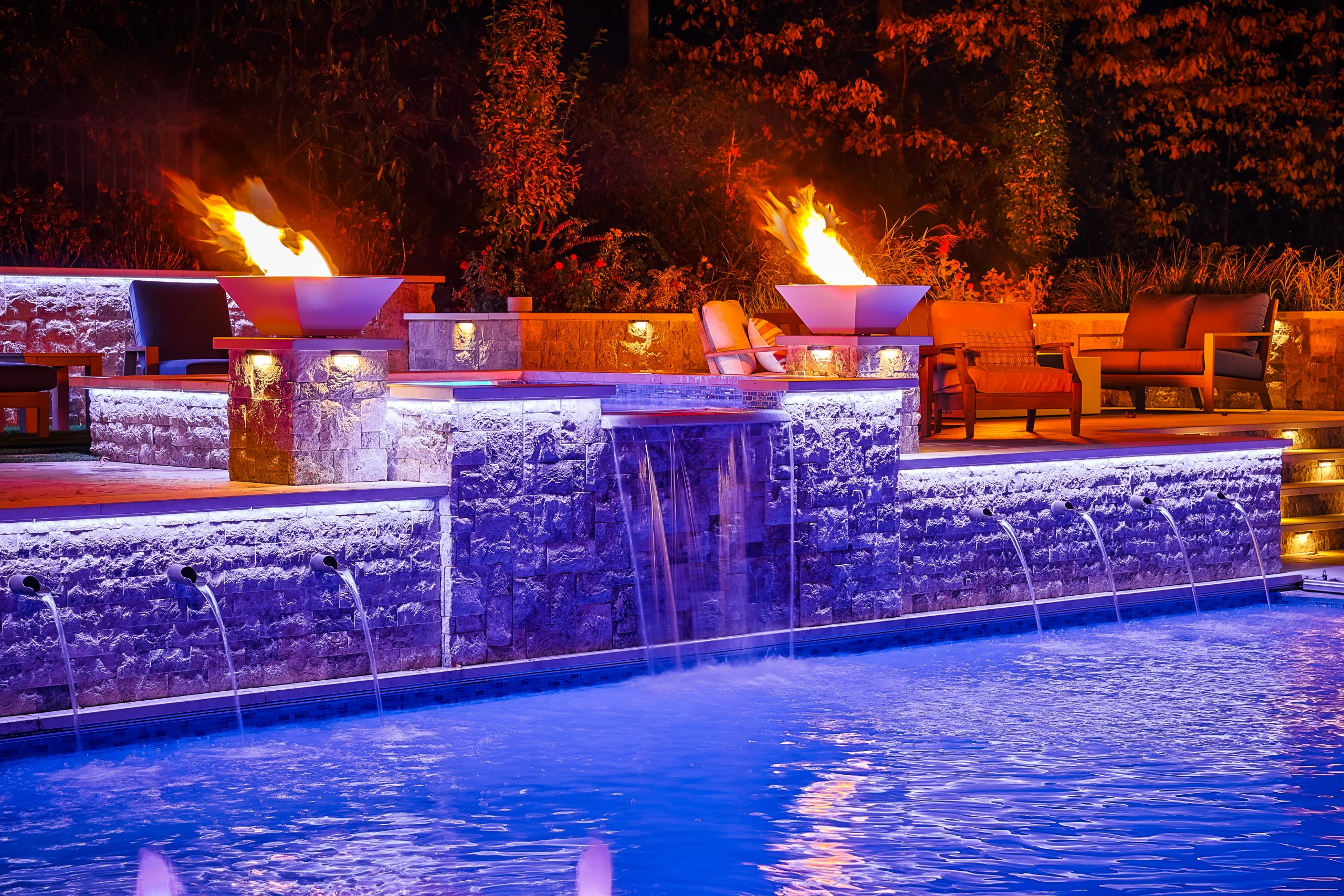
Sheer descent waterfalls offer a completely different aesthetic—sleek, modern, and quiet. Water flows through a thin spillway creating an elegant sheet that’s perfect for contemporary pool designs. These often get installed along raised walls and can be finished with glass tile or stacked stone.
Rock waterfall installation typically ranges from $8,000 to $20,000 depending on size and complexity, while sheer descent features run $1,000 to $5,000. The investment reflects not just materials but the engineering required to make them work correctly.
Cascade waterfalls create a natural look with water flowing over a series of steps or rocks. They’re ideal for homeowners who want that organic, resort-style feel. The sound is more pronounced than a sheer descent, which some people love for the way it masks neighborhood noise.
Installation quality makes or breaks these features. Unleveled waterfalls produce uneven flow—one side gushing while the other barely trickles. Proper installation means precise leveling, correct plumbing connections, and flow testing before finishing work. That’s not something you want to trust to inexperienced contractors.
Deck Jets, Bubblers, and Fountain Installation
Deck jets and laminar jets shoot arcs of water from the deck or coping into the pool. Kids love them. They’re interactive, adjustable, and when you a href=”https://jasaquatics.com/water-features/pool-led-lighting/”>add LED lighting, they become a nighttime focal point. Deck jets are particularly popular in Nassau County because they add drama without requiring major structural work.
Laminar jets create smooth, glass-like arcs of water that can reach seven to eight feet. They’re more expensive than standard deck jets but offer that high-end look. The key is proper placement—you need enough clearance, and they don’t perform well in windy locations.
Bubblers create playful fountains in shallow areas—tanning ledges, beach entries, or steps. They’re especially popular with families because they add an element of fun without overwhelming the design. Installation is straightforward since they’re built into the pool floor, but that means they need to be planned during new construction or major renovation.
Scuppers and spillover features bring a spa-like feel. Water flows from raised features—often decorative bowls or elevated spa edges—creating a gentle waterfall effect. They’re sophisticated, calming, and work well in smaller spaces where a full rock waterfall might overwhelm the design.
The key is matching the feature to your pool’s personality and your family’s actual use. A household with young kids might prioritize bubblers and deck jets. Someone designing an adult retreat might lean toward a quiet sheer descent paired with a spillover spa. There’s no wrong answer—just the right fit for your Nassau County property.
Professional Water Features Installation Process
Here’s the reality: water features installation is where a lot of pool projects go sideways. Homeowners assume any pool contractor can handle it, but that’s not always true. Proper installation requires understanding flow rates, pump capacity, plumbing integration, and structural load—especially when adding weight from rock features.
Uneven water flow is one of the most common problems. It happens when the feature isn’t level or when multiple waterfalls don’t have individual valves for balancing. You end up with one side gushing and the other barely trickling. Fixing it after the fact means tearing things apart.
Professional installation starts with design planning. That includes calculating gallons per minute requirements, determining pump sizing, planning plumbing routes, and coordinating electrical work. All of this happens before anyone breaks ground.
Plumbing and Electrical Requirements for Water Features
Plumbing is where most water feature problems originate. Some contractors try to tie features into the main pool circulation system to save money. That can work for small fountains or a single deck jet, but it often robs your filtration system of the flow it needs. Larger waterfalls or multiple features really should have dedicated plumbing loops with their own pumps.
Flow rate matters significantly. Most sheer descent manufacturers specify minimum flow rates—typically around 5 gallons per minute per linear foot. Ignore those specs and you get a disappointing trickle instead of a proper waterfall. Oversized pumps waste energy and create excessive noise.
Proper installation uses schedule 40 PVC pipe—never the thinner schedule 20. Ball valves get installed for flow control, and unions at strategic points make future service possible. Everything gets pressure tested before being covered with concrete or decking. Finding a leak after finishing work is a nightmare nobody wants.
Electrical work is another piece people underestimate. If you want lighting—and you should, because it transforms the feature at night—you need proper conduit, wet location boxes, and GFCI protection. Electrical lines run alongside plumbing but maintain safe separation.
For Nassau County installations, winterization planning is essential. All plumbing needs to drain completely before freezing temperatures arrive. Water left in lines expands when frozen and causes expensive damage. We account for this from the start with proper pitch and drain points.
And here’s something that catches people off guard: adding features to an existing pool costs significantly more than building them in from the start. You’re dealing with finished surfaces, established plumbing, and structural considerations. That’s why working with a builder who understands both new construction and renovation makes a difference.
Custom Pool Design with Integrated Water Features
Water features don’t exist in isolation. They’re part of a complete outdoor environment that includes your pool, hardscaping, landscaping, lighting, and how you actually use the space. Good design considers all of it.
Start with your pool’s style. A modern geometric pool with clean lines calls for different features than a natural lagoon-style design. Sheer descents, scuppers, and laminar jets complement contemporary aesthetics. Rock waterfalls, grottos, and natural stone features work better with organic, freeform pools.
But style is only part of the equation. Placement matters just as much. Positioning a waterfall near a lounge area or spa means you can enjoy the sound and visual effect from your most-used spaces. Integrating features into retaining walls or existing hardscape creates cohesion instead of feeling like an afterthought.
The homeowners who end up happiest with their Long Island pools are the ones who think beyond just the water. They’re planning outdoor kitchens, fire features, pergolas, custom landscaping—complete outdoor living spaces. And water features play a central role in tying it all together.
Imagine a setup where your waterfall flows into the pool near a built-in spa. Adjacent to that, you’ve got a covered pergola with an outdoor kitchen and seating area. Fire bowls provide warmth and ambiance in the evening. Landscape lighting highlights the waterfall and creates pathways. Everything works together.
This is where having a builder who handles more than just pool installation becomes valuable. When the same team is designing your pool, water features, hardscaping, and outdoor structures, you get cohesion. Materials match. Elevations work. Plumbing and electrical get planned together instead of being pieced together later.
Nassau County properties vary widely—some have expansive yards, others work with tighter footprints. Custom design means maximizing what you have. Maybe that’s a dramatic multi-tiered waterfall that becomes the centerpiece. Or maybe it’s a compact scupper feature that adds sophistication without overwhelming a smaller pool.
The best outdoor spaces feel intentional. Every element has a purpose and contributes to the overall experience. Water features shouldn’t feel random or disconnected. They should enhance the flow, support how you use the space, and create the atmosphere you’re after—whether that’s a peaceful retreat, an entertainment hub, or a family-friendly play area.
Choosing the Right Water Features Installation Company
Water features transform pools from functional to exceptional. They create atmosphere, improve water quality, add property value, and give you something worth showing off. But the difference between a feature that enhances your space and one that creates problems comes down to installation quality.
Professional installation means proper plumbing, correct flow rates, structural integrity, and seamless integration with your pool and outdoor living area. It means working with a team that understands both the technical requirements and the design vision. And it means having ongoing support after the project is complete—not a contractor who disappears the moment the final payment clears.
Whether you’re building a new pool or enhancing an existing one in Nassau County, the right water features make your backyard somewhere you actually want to spend time. We bring the expertise, local knowledge, and full-service approach that turns concepts into reality. From 3D design renderings to professional installation and ongoing maintenance, every piece is handled by our team that’s been transforming Long Island outdoor spaces since 2009.
Questions about your pool?
Tell us what you need and a JAS Aquatics pool pro on Long Island will get back to you. Prefer to talk now? Call 631-239-8031.