Summary:
Your pool light flickered once, then twice, then went dark completely. Now you’re standing at the edge of your pool wondering whether you need a simple repair or if it’s time for a full replacement. The quotes you’re getting range from a couple hundred dollars to well over a thousand, and nobody seems to be giving you a straight answer about which option makes financial sense. Here’s what you actually need to know about pool light repair versus LED upgrades, and how to figure out which one saves you money in Nassau County.
When Pool Light Repair Makes Financial Sense
Not every pool light problem requires a complete fixture replacement. If your light is relatively new and the fixture itself is in good condition, a repair can extend its life for years at a fraction of replacement cost.
Simple repairs typically cost between $65 and $150 per light. You’re looking at issues like a burned-out bulb, a worn gasket that’s letting water seep in, or a loose connection that’s causing flickering. These are straightforward fixes that don’t require tearing out the entire fixture or running new wiring.
The math works in your favor when the fixture is under five years old, the niche housing shows no corrosion, and you’re dealing with an isolated component failure. A $100 repair on a fixture that gives you another three to five years of reliable service beats spending $1,000 on a replacement you don’t actually need yet.
Pool Plumbing Repair Considerations for Light Fixtures
Pool lighting doesn’t exist in isolation from your pool’s other systems. The electrical conduit that powers your light runs through the same general pathway as your plumbing lines, and problems in one area can affect the other.
Water infiltration around a pool light fixture sometimes points to a bigger issue with your pool’s plumbing or structural integrity. If water is getting into your light housing, it might be coming from a crack in the pool shell, a failed pipe seal, or deteriorating grout around the niche. Fixing just the light without addressing the underlying water intrusion problem means you’ll be back in the same situation within months.
This is where experience with pool plumbing repair becomes valuable. A technician who understands how your pool’s systems work together can spot these connections. They’ll notice if your light niche is sitting in an area where your return lines are creating unusual pressure, or if the shell around your light shows signs of movement that suggests a deeper structural issue.
In Nassau County, the freeze-thaw cycles we get each winter put extra stress on pool structures. Hairline cracks that seem minor in summer can expand significantly when water freezes in them. If your pool light is installed in an area that’s vulnerable to this kind of seasonal movement, addressing the plumbing and structural concerns becomes part of the lighting repair equation.
The cost of a combined approach depends on what’s discovered during assessment. Sometimes it’s as simple as resealing the light niche and replacing a gasket for under $200. Other times, you’re looking at more extensive work that includes patching the pool shell, rerouting a problematic return line, or updating the entire electrical conduit system.
What matters is getting an honest assessment from someone who can evaluate the complete picture. A pool company that only does lighting work might miss plumbing issues that will undermine your repair. We handle comprehensive pool services, so we can identify and address related problems before they turn your light repair into a recurring expense.
Signs Your Pool Light Needs Immediate Professional Attention
Some pool light problems aren’t just inconvenient. They’re safety hazards that require immediate professional evaluation, regardless of whether you ultimately repair or replace the fixture.
Water inside your light housing is the clearest red flag. Pool lights are designed to be completely sealed systems. When water gets past the gasket and lens, you’ve got a compromised fixture that’s mixing electricity with water in ways it was never engineered to handle. Even if the light still works, continuing to use it creates a shock hazard. This isn’t a “wait and see” situation. The fixture needs to be pulled, evaluated, and either properly resealed or replaced.
Flickering lights can indicate loose wiring, a failing transformer, or corrosion in the electrical connections. Occasionally a flicker just means a bulb is nearing the end of its life, but persistent flickering points to electrical instability. In underwater applications where GFCI protection is your main safety backup, you don’t want to ignore signs of electrical problems.
Tripped breakers every time you turn the light on mean the circuit is detecting a fault. Your breaker is doing its job by shutting down power before someone gets hurt. The fault might be in the light fixture itself, in the wiring conduit, at the junction box, or in the transformer. Finding the source requires proper diagnostic equipment and knowledge of pool electrical systems.
Visible corrosion around the light fixture, especially on metal components or wiring connections, accelerates in coastal areas like Nassau County. Salt air speeds up the deterioration process. What starts as surface rust can compromise the structural integrity of mounting hardware and create gaps where water infiltrates. Once corrosion reaches the wiring itself, you’re past the point where a simple repair makes sense.
Discoloration in the water around the light sometimes indicates the fixture is running too hot, which happens when ventilation is blocked or the wrong wattage bulb was installed. Overheating can damage the fixture housing, melt gaskets, and create fire risks in the junction box area.
Age matters too. If your pool light fixture is 15 or 20 years old and showing any of these symptoms, you’re likely looking at a situation where the entire system has reached the end of its useful life. The wiring insulation becomes brittle over time, gaskets lose their flexibility, and metal components fatigue. Trying to repair individual components on a fixture that old often just delays the inevitable while putting your family at risk.
Nassau County code requires that pool electrical work be performed by licensed electricians who understand NEC Article 680 requirements. This isn’t general residential electrical work. The standards for underwater lighting, bonding, grounding, and GFCI protection are specific and exist because the consequences of failure are severe. A homeowner attempting DIY pool light repair without proper training and equipment can create hazards that aren’t immediately obvious but can be fatal.
LED Pool Light Replacement: When the Upgrade Pays for Itself
LED pool light replacement costs more upfront than a simple repair, but the math changes when you factor in energy savings, lifespan, and avoided future repairs. For many Nassau County pool owners, the upgrade pays for itself within two years.
A typical LED pool light replacement runs between $700 and $1,500 depending on the fixture size and features. That’s significantly more than a $100 repair, which makes homeowners hesitate. But here’s what that upfront cost actually buys you.
LED lights use about 80% less electricity than the halogen or incandescent fixtures they replace. If you’re currently running a 300-500 watt halogen light for six hours a night during pool season, you’re consuming roughly 540-900 kilowatt hours per year per light. At Nassau County electricity rates, that’s $100-$180 annually per light. An LED equivalent uses 40-65 watts and costs $20-$35 per year to operate. You’re saving $80-$145 per light every single year on your electric bill.
LED Pool Light Replacement Cost Breakdown for Nassau County
Understanding what you’re actually paying for in an LED pool light replacement helps you evaluate quotes and make informed decisions. The total cost breaks down into several components, and knowing what drives the price helps you spot fair pricing versus inflated estimates.
The LED fixture itself typically costs between $200 and $900 depending on size, brand, and features. Basic white LED lights sit at the lower end. Color-changing LEDs with multiple lighting programs and remote control capabilities cost more. Premium brands like Pentair IntelliBrite or Hayward ColorLogic command higher prices but come with better warranties and proven reliability in harsh pool environments.
Installation labor adds $300 to $800 to your total cost. This covers shutting down power, pulling the old fixture, running new wiring if needed, installing the new LED light, testing all connections, and ensuring everything meets code. The wide range reflects the complexity of your specific installation. A straightforward replacement in a pool with good existing conduit and easy access might take two hours. A situation requiring new wiring runs, conduit repairs, or difficult access can take a full day.
Electrical components sometimes need updating as part of the conversion. LED lights often require a transformer to step down voltage to the 12V systems that are now standard for safety. If your existing setup doesn’t have the right transformer, that’s an additional $100-$300. GFCI outlets and breakers might need upgrading to meet current code requirements, adding another $50-$200 to the project.
Permits and inspections in Nassau County add to the cost when you’re doing electrical work. The permit itself might run $50-$150, and having a licensed electrician handle the inspection coordination is part of what you’re paying for in professional installation. This isn’t a hidden cost—it’s protecting you from code violations and insurance issues down the road.
Related repairs discovered during installation can change your estimate. If we find corroded wiring in the conduit, a cracked light niche, or junction box problems, addressing those issues adds to the scope. We’ll show you the problem, explain why it needs fixing, and give you options. This is actually a benefit of professional installation—these issues get caught before they become emergencies.
The total cost for LED pool light replacement in Nassau County typically lands between $700 for a basic single-light upgrade in good conditions and $1,500 for a larger color-changing system with some electrical updates. If you have multiple lights, doing them all at once usually saves on labor costs since we’re already set up and working on your pool’s electrical system.
Compare that total cost to the alternative. If you repair an old halogen light for $150 today, you’ll spend another $100-$180 per year on electricity to run it. Within two years, you’ve spent more than the LED upgrade would have cost, and you’re still running an outdated, inefficient fixture that will likely need another repair or full replacement soon anyway.
Energy Savings and Lifespan: The Real ROI on LED Upgrades
The return on investment for LED pool light replacement becomes clear when you calculate the total cost of ownership over the fixture’s lifespan, not just the upfront installation price.
LED pool lights last 20,000 to 50,000 hours depending on the quality of the fixture and how you use it. If you run your pool lights six hours per night during a six-month pool season in Nassau County, that’s roughly 1,100 hours per year. Even at the conservative end of LED lifespan estimates, you’re looking at 18-20 years before you need to think about replacement. Compare that to incandescent bulbs that last 1,000-5,000 hours, which means you’re replacing them every one to three years.
The energy savings add up faster than most people realize. Let’s run real numbers for a Nassau County pool with two lights. Your old 400-watt halogen fixtures running six hours nightly for six months consume 1,460 kilowatt hours annually. At $0.19 per kWh (typical for Long Island), that’s $277 per year just to light your pool. Switch to 50-watt LEDs and you’re down to 182 kilowatt hours and $35 annually. You’re saving $242 every single year.
That $1,400 you spent on LED replacement for both lights? You break even in less than six years just on electricity savings. Then you have another 12-15 years of savings ahead of you, totaling over $3,000 in avoided energy costs. And that’s before you factor in the money you’re not spending on replacement bulbs, repair calls, and the time you’re not wasting dealing with burned-out lights.
Maintenance costs drop dramatically with LEDs. Traditional pool lights need bulb replacements every 1-3 years at $30-$70 per bulb plus labor if you’re not doing it yourself. Gaskets need replacement every few years at $25-$50 each. If you’re paying for service calls, you’re spending $150-$200 each time something needs attention. Over a 15-year period with traditional lighting, you might easily spend $1,500-$2,500 on maintenance and repairs. LED systems typically require zero maintenance during that same timeframe.
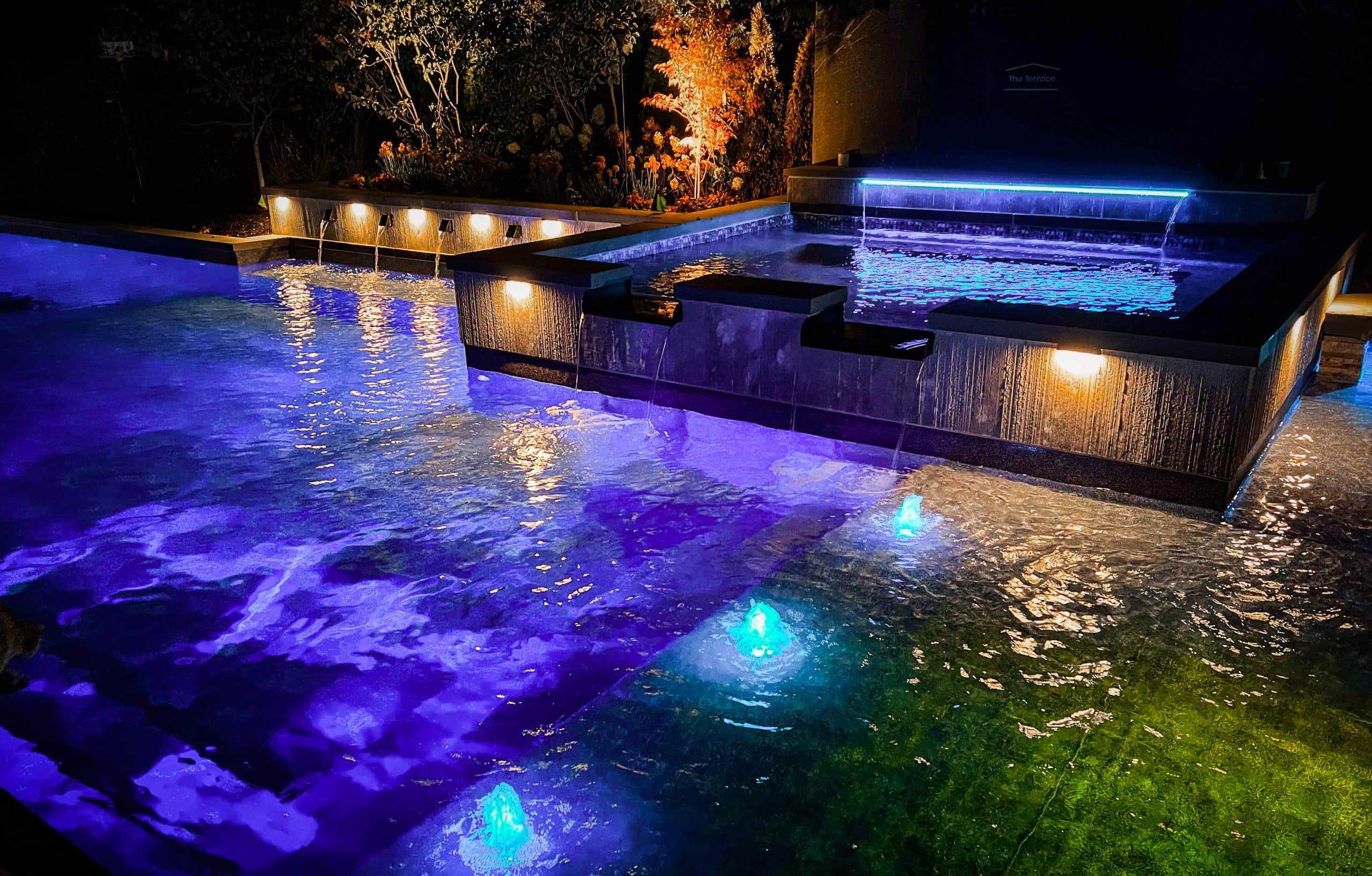
Property value benefits are harder to quantify but real. Modern LED pool lighting with color-changing capabilities and smart controls is an expected feature in updated pools. When you eventually sell your home, outdated pool lighting signals to buyers that other pool equipment might be aging too. Updated a href=”https://jasaquatics.com/water-features/pool-led-lighting/”>LED lighting contributes to the overall impression of a well-maintained property.
Insurance and liability considerations matter more than most homeowners realize. Old pool lighting with corroded fixtures, questionable wiring, or improper GFCI protection creates liability exposure. If someone is injured in your pool and an investigation reveals your pool lighting wasn’t up to code, you’re facing serious legal and financial consequences. Professional LED installation brings everything up to current standards and gives you documentation that the work was done right.
The environmental impact isn’t usually the primary decision driver, but it’s worth noting. Reducing your pool lighting energy consumption by 80% means you’re pulling less power from the grid. Over the 20-year lifespan of LED fixtures, that’s a significant reduction in your home’s carbon footprint. For homeowners who care about sustainability, it’s an additional benefit that aligns financial savings with environmental responsibility.
Making the Right Choice for Your Pool Lighting in Nassau County
The decision between pool light repair and LED upgrade isn’t always obvious, but the framework is straightforward. If your fixture is relatively new, the problem is isolated to a single component, and you’re not concerned about energy costs, a repair can give you several more years of service at minimal cost. If your fixture is over 10 years old, you’re running expensive halogen or incandescent lights, or you’re dealing with recurring problems, LED replacement delivers better long-term value.
What matters most is getting an honest professional assessment from someone who understands pool electrical systems, Nassau County code requirements, and the specific challenges of Long Island’s climate. You need someone who can evaluate your complete situation and give you options that make sense for your goals and budget.
We bring that combination of technical expertise and practical experience to every pool lighting project in Nassau County. Whether you need a straightforward repair or a complete LED upgrade, you’ll get clear information about what’s involved, what it costs, and what results you can expect. Reach out to discuss your pool lighting situation and get answers that help you make the right choice.
Questions about your pool?
Tell us what you need and a JAS Aquatics pool pro on Long Island will get back to you. Prefer to talk now? Call 631-239-8031.